

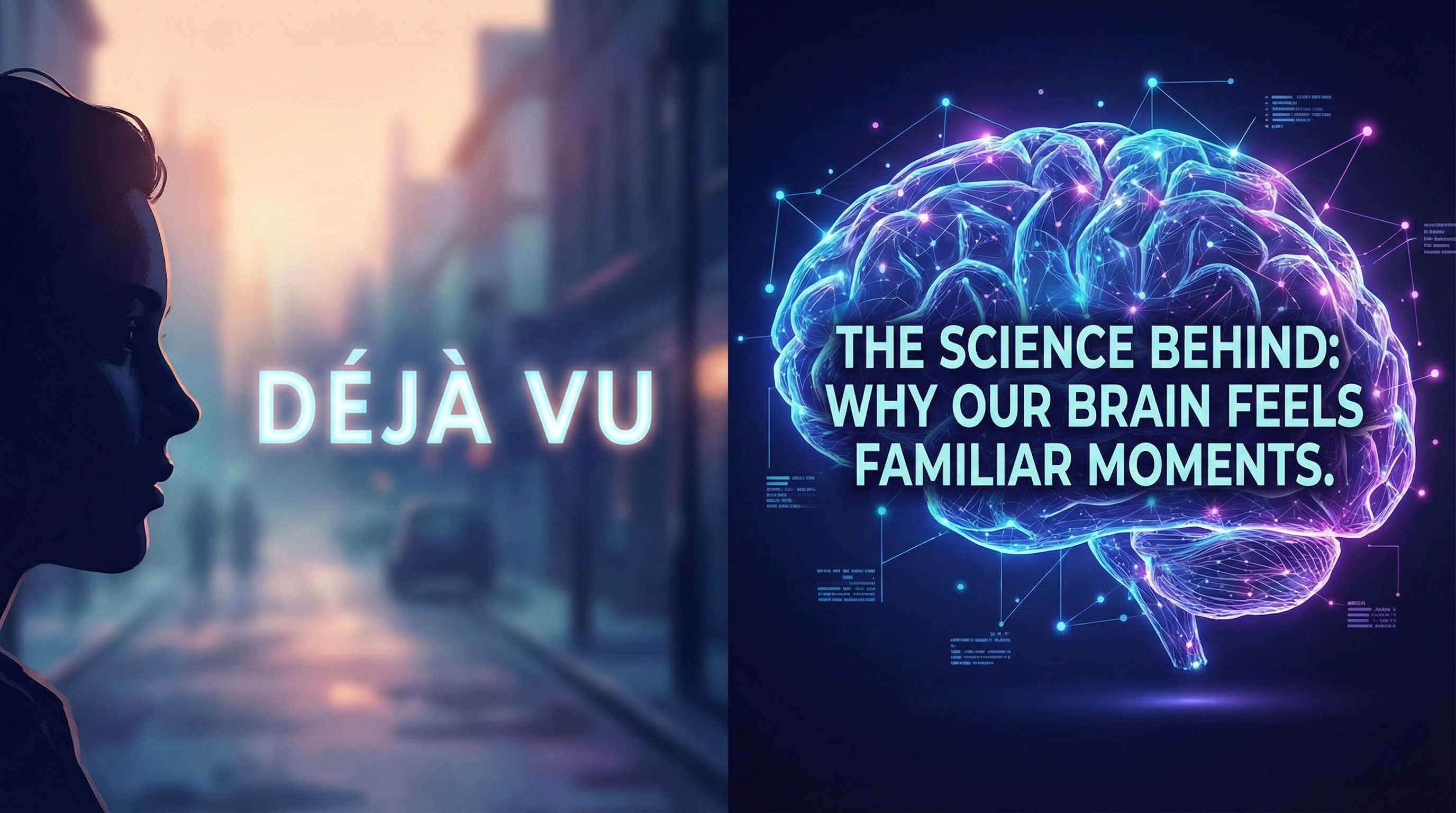
Déjà vu — a French term meaning “already seen” — is a peculiar and sometimes unsettling phenomenon. Almost everyone experiences it at least once in their lifetime: that eerie feeling that a current situation has already happened, even when logic tells us it hasn’t.
Despite its familiarity, déjà vu remains a puzzle in neuroscience and psychology. Researchers have explored it from multiple angles — from brain activity to memory systems, and even theories touching on perception and consciousness.
How Common is Déjà Vu?
Studies suggest that around 60–70% of people experience déjà vu at some point. It’s most common in young adults, particularly those between 15 and 25, and tends to decline with age. Interestingly, the phenomenon occurs slightly more in people with higher education levels, possibly linked to their active memory and recognition systems.
Although fleeting — often lasting only a few seconds — the sensation can be vivid, leaving an impression that lingers for minutes or even hours.
The Brain and Memory: A Misfire in Recognition
One of the most widely accepted explanations involves memory systems. Déjà vu may occur due to a mismatch between short-term and long-term memory.
Our brain constantly processes sensory input, comparing current experiences with stored memories. Sometimes, these systems misfire, triggering the sensation that a new event is somehow familiar.
Neuroscientists believe this could involve the temporal lobe, particularly the hippocampus — the brain’s memory hub. If the hippocampus processes the experience slightly out of sync, it may create a false sense of familiarity.
Dual Processing Theory
Another explanation is the dual processing theory, which suggests that our brain processes information along two parallel pathways:
-
Conscious perception – when we actively observe and recognize events.
-
Unconscious perception – when sensory input is processed without awareness.
When these two pathways momentarily get out of sync, the brain interprets a familiar unconscious perception as if it has already consciously occurred. This misalignment can trigger déjà vu.
Déjà Vu and Temporal Lobe Epilepsy
In some cases, déjà vu is linked to temporal lobe epilepsy (TLE). People with TLE often experience intense, recurring déjà vu episodes just before a seizure.
Researchers use these cases to study the neurological basis of déjà vu, observing brain activity during episodes. Findings suggest that electrical disturbances in the temporal lobe can trigger sensations of false familiarity — providing strong evidence for a neurological explanation.
Psychological Theories: Memory and Cognition
Psychologists also consider cognitive explanations. One idea is that déjà vu occurs when current experiences resemble past ones, but the memory is incomplete or repressed. Our subconscious recognizes the similarity, but we are unable to consciously place it, creating a feeling of familiarity without context.
Another hypothesis involves attention and perception lapses. If our attention momentarily drifts, the brain may register the same scene twice, producing a false sense of having already experienced it.
Déjà Vu Across Cultures
Interestingly, the experience of déjà vu transcends culture. People worldwide report similar feelings, though interpretation varies:
-
Some cultures view it as a spiritual or prophetic sign.
-
Others consider it a psychological quirk or minor glitch in perception.
Despite cultural differences, the underlying experience — that strange mix of familiarity and uncertainty — remains remarkably consistent.
Why We Remember Some Déjà Vu Episodes
Most déjà vu events are brief and forgotten. Yet, occasionally, the memory of an episode persists vividly. This might be because emotion enhances memory encoding.
When déjà vu coincides with stress, excitement, or curiosity, the brain marks it as significant. The hippocampus strengthens these memories, allowing us to recall the moment long after it passes.
Everyday Triggers and Conditions
While spontaneous déjà vu occurs unpredictably, certain conditions may increase its likelihood:
-
Fatigue or stress – when cognitive processing slows or becomes erratic.
-
New environments – unfamiliar locations resembling previous experiences.
-
Travel or jet lag – altering perception of time and space.
-
Meditation or daydreaming – when attention shifts inward, creating a disconnect between perception and memory.
Understanding these triggers helps demystify déjà vu, showing it’s a natural, albeit peculiar, cognitive event rather than a supernatural occurrence.
Scientific Research and Experiments
Researchers have used both brain imaging and cognitive experiments to study déjà vu.
-
fMRI studies reveal temporary hyperactivity in the temporal lobe during the sensation.
-
Memory recognition tests show that familiarity can be induced by subtle visual or auditory cues.
-
Psychological surveys correlate déjà vu frequency with personality traits such as curiosity and openness to experience.
These studies help map the phenomenon scientifically, connecting subjective experience with neurological processes.
Conclusion: A Glimpse Into the Mind
Déjà vu is more than a fleeting curiosity. It provides insight into the brain’s memory systems, perception, and consciousness. By studying it, scientists explore how we experience reality, recognize patterns, and store memories.
While the exact cause remains elusive, theories ranging from memory mismatches to temporal lobe activity offer plausible explanations. Each episode of déjà vu reminds us that human perception is intricate, delicate, and occasionally mysterious — a reminder that even ordinary moments may carry hidden layers of complexity.
Understanding déjà vu allows us to appreciate the extraordinary nature of our everyday experiences — a silent testament to the brain’s immense power and subtle glitches.