

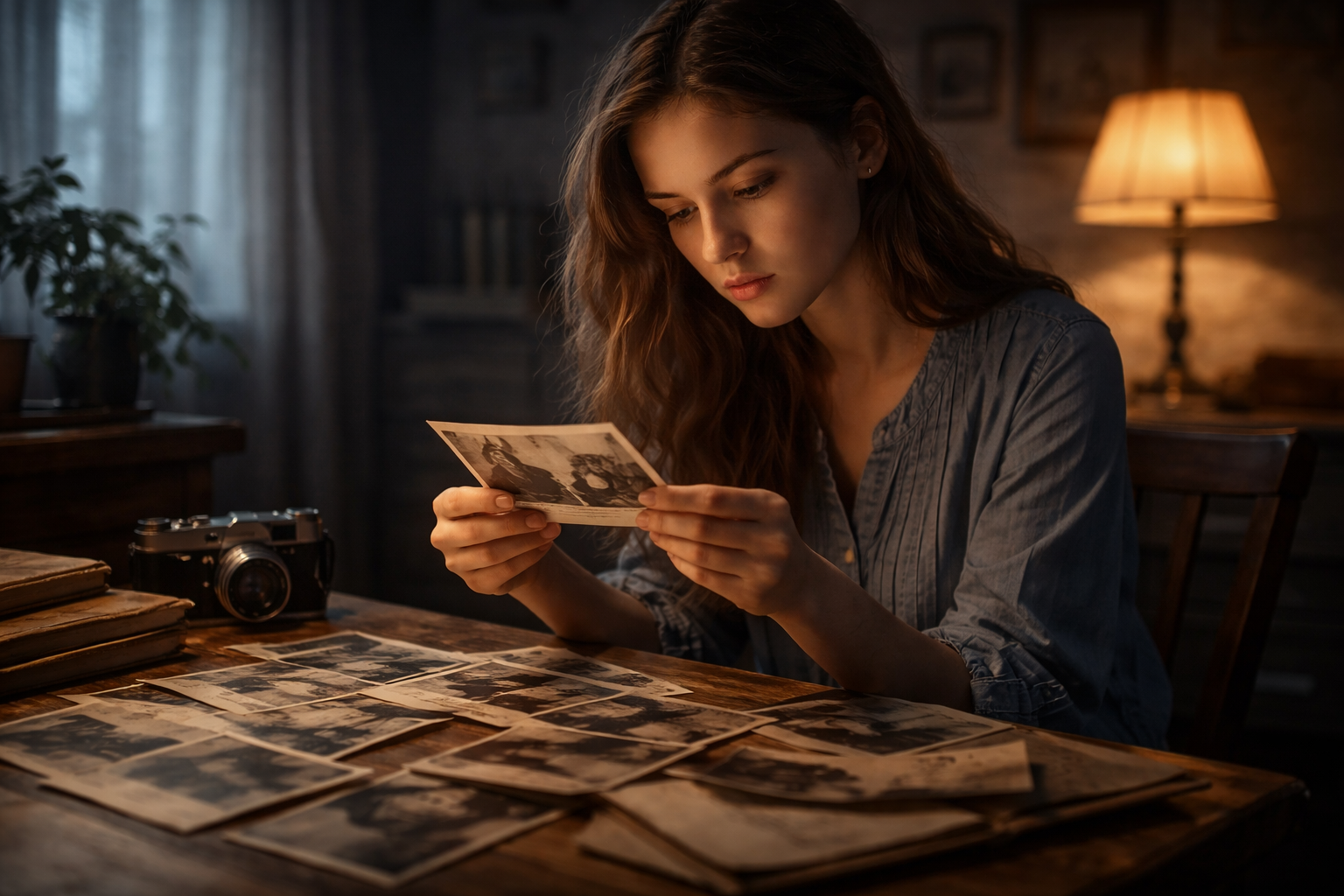
The girl discovered her ability by accident. There was no dramatic moment, no sudden realization. It happened quietly, the way most life-changing things do.
She was sorting through an old box of photographs one afternoon — images of strangers collected from flea markets and forgotten homes. As her fingers brushed against one photo, her vision blurred. The room faded, replaced by a moment that was not her own.
She saw laughter. She felt warmth. She smelled rain.
And then it was gone.
From that day on, photographs were no longer still images to her. They were doors.
Seeing Beyond the Frame
Every photograph carried something hidden beneath its surface. When she touched them, the past unfolded — not as a story, but as a feeling.
She didn’t just see memories. She experienced them.
Joy rushed through her chest when she held wedding photos. Heavy silence pressed on her lungs when she touched images taken moments before tragedy. Even blurred or damaged photos carried echoes — faint, but undeniable.
The clearer the image, the stronger the memory.
The Weight of Other People’s Lives
At first, she was curious. Then she became overwhelmed.
Some memories were beautiful — children running through sunlight, friends sharing secrets, quiet moments of peace. Others were unbearable.
She felt grief that was never hers. Fear she never lived through. Love that ended long before she was born.
Each photograph left something behind. The memories faded quickly, but the emotions lingered.
She began to understand that remembering someone else’s life came with a cost.
Why Photographs Hold So Much Power
Photographs freeze time. They capture moments people believe will last forever.
What the girl realized was this: memories cling to intention.
The stronger the emotion when the photo was taken, the deeper it embedded itself into the image. Cameras didn’t just record light — they absorbed meaning.
That was why some photos felt empty, while others felt alive.
Learning to Control the Visions
For a long time, she avoided touching photos altogether. Gloves became her shield. Distance became her defense.
But curiosity always returned.
She learned to focus. To pull back before the memory overwhelmed her. With practice, she could choose how deeply she entered each moment.
She never stayed long.
Staying too long made it harder to return.
The Photograph That Changed Everything
One photograph refused to let her go.
It was a simple image — a young girl standing alone on a train platform, holding a small suitcase. No date. No name. No destination.
The moment she touched it, the world dissolved.
She felt cold air on her skin. Fear tightened her chest. The girl in the photograph was waiting for someone who never came.
The memory did not end.
Trapped Inside a Stranger’s Past
Minutes passed. Then hours.
The platform stretched endlessly. Trains arrived and left, but no one approached the girl. The weight of abandonment pressed harder with every passing second.
The memory was unfinished.
The girl realized something terrifying: some photographs contained moments that never resolved. And once inside, leaving was not guaranteed.
The Truth About Unfinished Memories
Unfinished moments are powerful. They linger longer. They resist closure.
The photograph wasn’t just holding a memory — it was holding a question.
What happened next?
And until that question was answered, the memory refused to release her.
Finding a Way Back
She focused on the smallest detail — the suitcase.
It was worn, scratched, heavy with meaning. She imagined setting it down. Imagined choosing to leave instead of waiting.
The platform faded.
She collapsed onto the floor of her room, shaking, the photograph slipping from her hand.
From that moment on, she understood the true danger of her gift.
Why Some Memories Should Remain Untouched
Not all memories want to be revisited.
Some exist only to teach absence. To remind the world of moments that shaped people quietly, painfully.
The girl learned to respect those boundaries. She stopped seeking meaning in every image.
Some stories were meant to stay silent.
The Responsibility of Remembering
With time, she used her ability carefully.
She helped historians understand lost moments. She returned emotional truth to forgotten lives. She gave closure where it was possible.
But she never tried to change what had already happened.
Memories were not meant to be rewritten — only understood.
The Loneliness of Knowing Too Much
The gift isolated her.
She couldn’t explain why certain photos made her cry. Why she avoided albums others treasured. Why she sometimes smiled at images no one else noticed.
Knowing too much about the past made the present feel fragile.
Every moment suddenly felt temporary.
The Final Photograph
Years later, she took a photograph of herself.
Just one.
She placed it carefully inside a box and sealed it away, never touching it again.
Some memories, she decided, deserved to remain unseen — even her own.
The Last Lesson the Photographs Taught Her
Memories do not live in images.
They live in people.
Photographs only remind us of what we choose not to forget.
And sometimes, forgetting is an act of mercy.